

Most search advice comes from Europe and America. It tells you to chase “near me” searches, and it assumes your customer searches the way a customer in London does.
I wanted to see whether that holds here. So on 31 October 2026 I ran 39 comparisons in Google Trends, looking at five years of searches from Uganda and repeating the main ones over the latest 12 months. I also compared Uganda with Kenya, Nigeria and the UK.
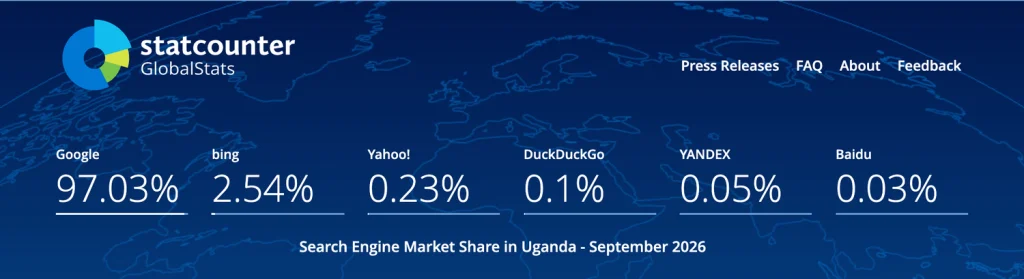
Google is the right place to look. It had 97% of Uganda’s search traffic in September 2026, according to Statcounter, and phones made up 67% of the web traffic it measured.
Trends doesn’t show how many people searched. It shows how popular one search is compared with another, so read every number below as a comparison, not a count.
People search for the name, not the category
Look at what people in Uganda search alongside the word “hotel” and you don’t get advice about hotels. You get Serena, Protea, Onomo, Fairway and Sheraton. “Pharmacy” brings up First Pharmacy, and “hospital” brings up Kampala Hospital, Mulago and Mengo.
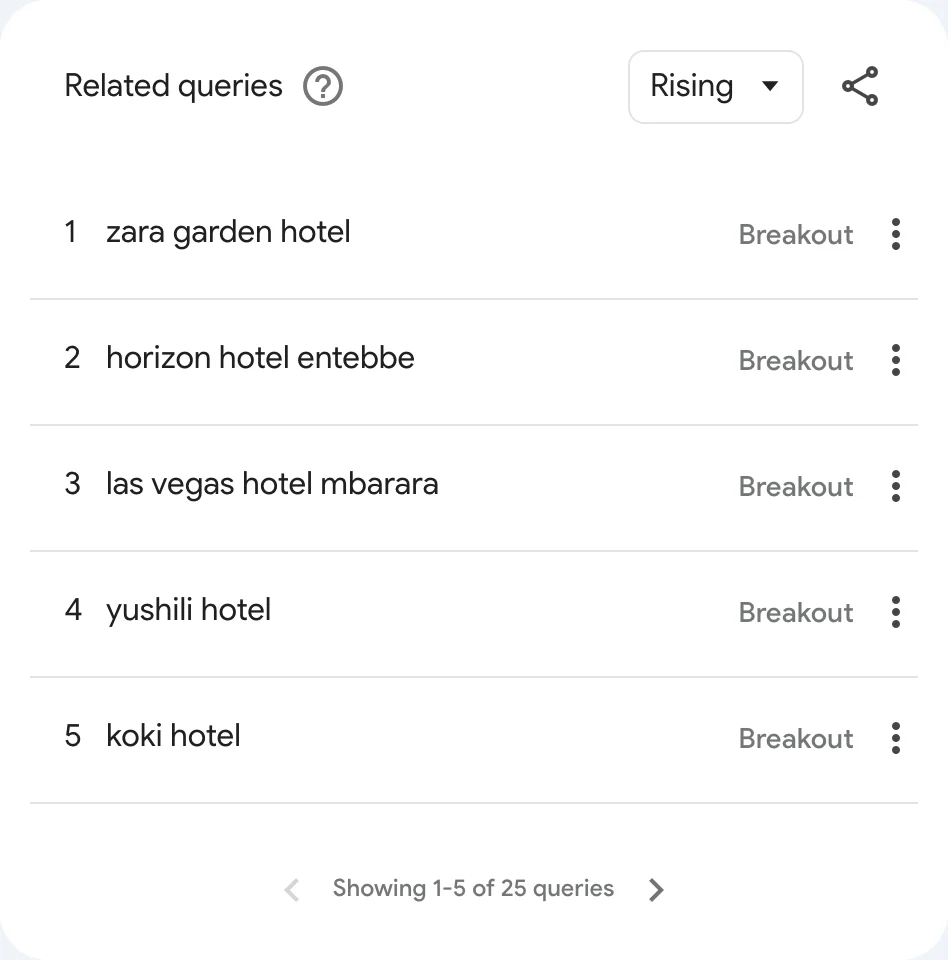
In other words, many people already know who they want. They use Google to get there. The same habit shows up in searches like “URA website”, “NIRA website” and “Facebook login”. For a lot of people, Google is how you open a website.
Sometimes they add the area too, as in “First Pharmacy Wandegeya”.
This should change your priorities. Before you worry about ranking for “best restaurant in Kampala”, search your own business name on a phone. You should come up first, with the right number and the right location. If someone who already wants you can’t find you, nothing else matters.
“In Uganda” beats “near me”
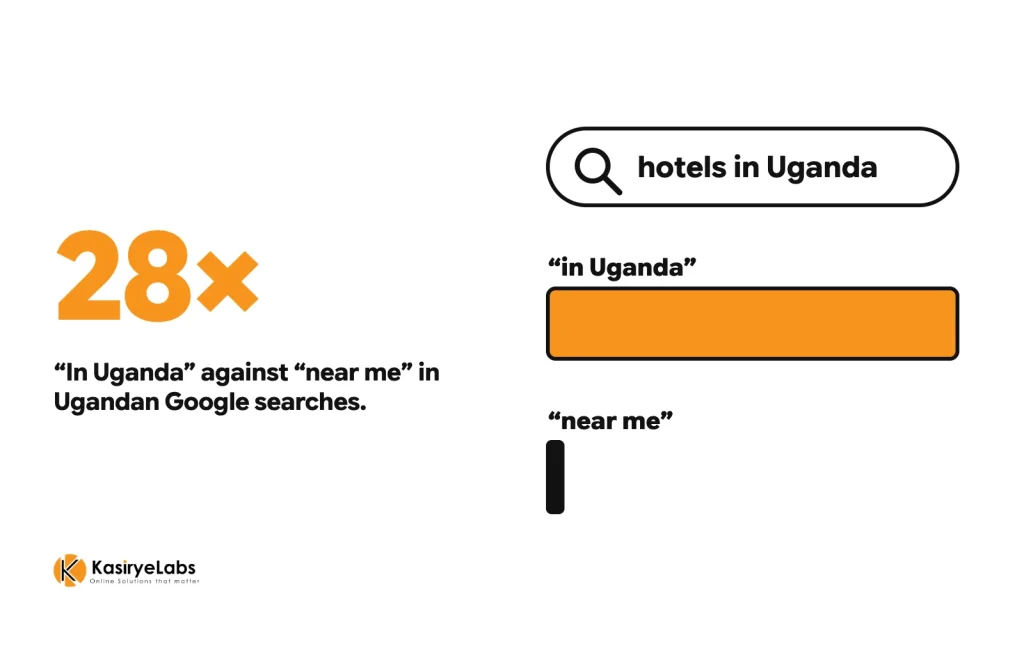
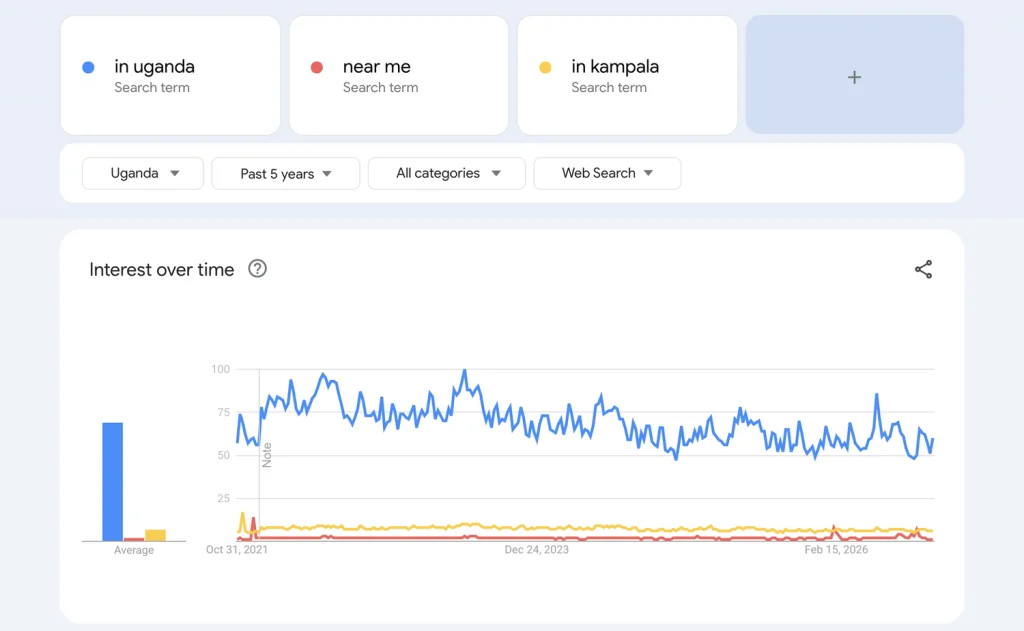
Over five years, searches containing “in Uganda” were about 28 times as popular as searches containing “near me”. “In Kampala” was about three times as popular.
The gap with our neighbours is clear for hotels. Across the last 12 months, “near me” appeared in more than one of every 100 hotel searches in Kenya, about 1.5 in Nigeria and close to 2 in the UK. In Uganda it was too small for Google to measure in nearly every week.
Restaurants show the same thing with a bigger signal: about 1 in every 100 searches in Uganda, against 5 or 6 in Kenya and Nigeria and nearly 8 in the UK.
A word of caution, because Trends rounds small numbers down to zero and that makes Uganda look lower than it is. “Near me” is real here. It’s the top related search for “guest house”, and it shows up beside restaurants, clinics and pharmacies. It just isn’t the main way people search, so it shouldn’t be the main thing you plan around.
You also don’t need the words on your site to appear for those searches. Google says local results depend on relevance, distance and how well known a business is, so a good Business Profile does that work. Your website copy should say the plain thing people actually type: what you do, in which town.
Kampala gets the searches, but use your town’s name
Over the last 12 months, “hotels in Kampala” was about 11 times as popular as “hotels in Entebbe”, the next highest of the five towns we compared. Jinja, Mbarara and Gulu were close behind Entebbe.
If you’re outside Kampala, that’s a good thing. There are fewer people searching, but there’s also less competition. Put your town’s name in your page titles and headings, not just in the footer.
People want the price
This was the clearest result. “Price in Uganda” was about nine times as popular as “cost in Uganda”. “How much” rose by around 40% between the first year of the data and the latest year.
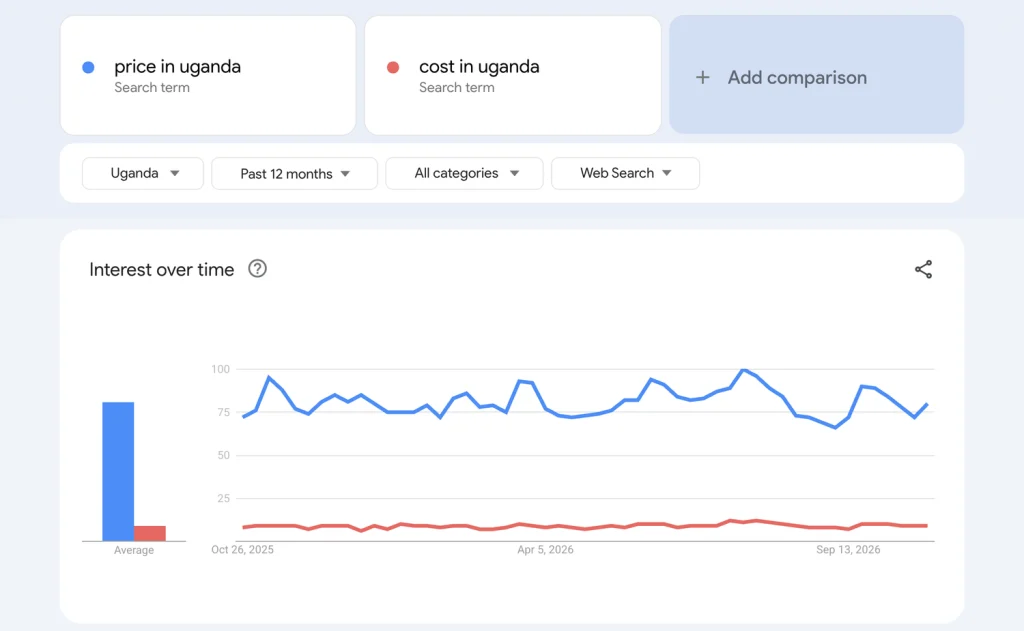
Phones lead those searches, by a long way: iPhone, Samsung, Tecno Camon. Coffee, gold and fuel prices are there too. But look at the longer phrases: “used cars for sale in Uganda with prices”, “salon equipment price list”, even “guest house near me low price list”.
Those people are telling you exactly what they want. If you sell something with a fixed price, put it on the page and use the words “price” and “Uganda” beside it. Custom work is different, but even there a starting price helps.
They also ask what’s true today
The word “today” keeps turning up: “jobs in Uganda today”, “coffee prices in Uganda today”. So do “open pharmacy near me”, “24 hour pharmacy near me” and “restaurants near me open now”.
Someone typing those wants to know what’s true right now. A “latest offers” page from 2023 fails them. Keep your hours, stock and prices current, on your site and on your Business Profile, and put a date on anything that changes.
Check your words against theirs
Some of the most useful results were small differences in wording:
- Car rental, not car hire. Both are small searches with many empty weeks, so treat this as a lean, not a rule. Five years ago the two were close, and in the latest year “car rental” averaged about four times “car hire”. Some of those searches may come from visitors, as “car rental Uganda” and 4×4 rentals lead the related searches.
- Salon and saloon. “Hair salon” is more than three times as popular as “hair saloon”, but both are real. Your page can use both naturally.
- TikTok over Facebook. Searches containing “Facebook” fell by more than half across the five years while “TikTok” more than tripled. That measures searches for the apps, not how much people use them. It’s still a useful sign of where attention moved.
- English for now. The few Luganda words we tested barely registered. That doesn’t mean people don’t speak Luganda to each other about your business. It means they mostly don’t type it into Google.
My own trade gets very few searches
Here’s an awkward result. Searches containing “website” were more than 100 times as popular as “website design”. Most are people looking for a specific site, or asking how to build one. Very few people search for a web designer in Uganda.
So a business like mine can’t rely on people searching for what we do. Many trades are in the same position. Accountants, consultants and specialist contractors are often found through a recommendation, and the customer then checks them on Google. That takes us back to the first point: when they search your name, what do they find?
What I’d do this week
- Search your business name on a phone and fix whatever comes up wrong.
- Claim and complete your Google Business Profile, with your hours, location and real photos.
- Rewrite your main page titles in plain words: what you do, and in which town.
- Put your prices on the page, or a starting price if the work varies.
- Ask five customers what they’d type to find a business like yours, then use their words.
How we did this
We used Google Trends for Uganda on 31 October 2026, with weekly data for the five years to 25 October 2026 and for the latest 12 months. The figures are averages from 39 comparisons. We also read the related searches Google lists for each term. Those can include people who are curious, students and job seekers, not just buyers.
There are limits. Trends scores are relative, get rounded and leave out very small searches, so small differences mean little. Results shift a little each time you pull them. A search for “hotel” also catches any search containing that word, such as “hotel jobs”. Trends can’t see voice searches as a separate group, or tell you who bought anything. Treat this as a picture of habits, not a measure of customers.
Sources
- Google Trends, Uganda, data pulled 31 October 2026
- Google Trends Help: how Trends data is adjusted
- Statcounter: search engine market share in Uganda, September 2026
- Statcounter: desktop, mobile and tablet share in Uganda, September 2026
- Google Business Profile Help: how local results are ranked




Comments
No comments yet — start the conversation.